

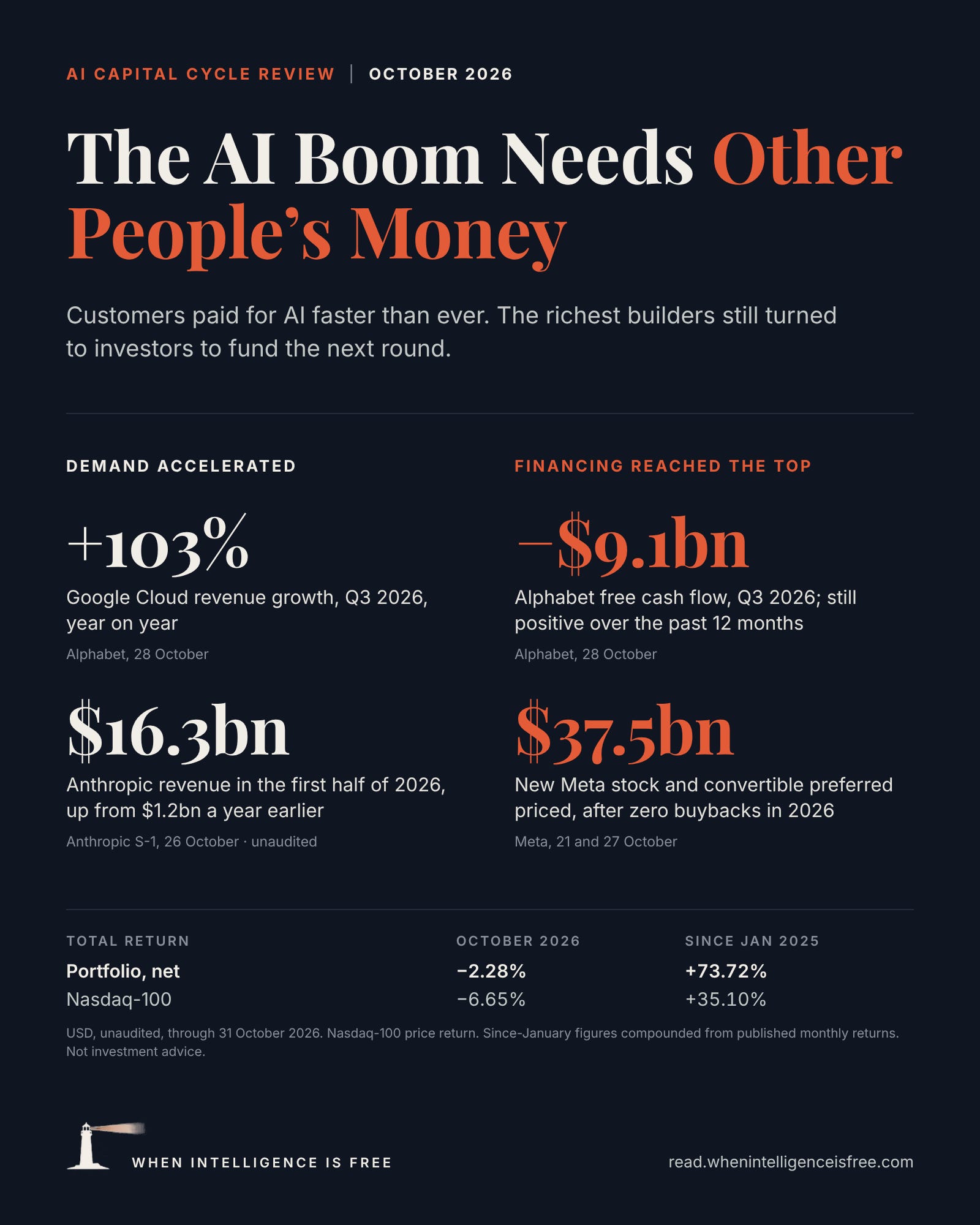
On 28 October, Alphabet reported the fastest growth Google Cloud has recorded: revenue up 103% to $30.7bn. The next day its shares fell 13%, the stock’s worst day on record and the second-largest one-day loss of market value in US history. Investors had other reasons to be disappointed, including weaker search revenue and missed earnings forecasts. But the contradiction worth following sat inside the results release. Alphabet spent $51.4bn on property and equipment in the quarter, more than the $42.3bn of cash its entire business generated, leaving free cash flow at minus $9.1bn. Microsoft, which also reported surging cloud growth but still generates free cash flow after its spending, slipped 0.2% the same day.
That is October in one company. The demand is real and accelerating. The bill for serving it has outgrown what even the richest builders earn, so they are bringing in lenders and new shareholders, and outside money arrives with a claim on the reward. My reading is that the market is becoming less willing to treat rapid AI growth as a complete investment case. The customers can be real, the business can grow, and the return to an existing shareholder can still disappoint. October sharpened two questions: what must the builders give up to finance their next expansion, and which businesses can earn without waiting for it?
When Intelligence Is Free researches how AI reshapes the economy: where profits disappear, where new opportunities emerge, and how to invest through the transition. These monthly reviews follow its capital cycle—from the rush to build, through the test of returns, to AI’s spread through the wider economy. October showed the strain of the first phase reaching its strongest builders.
The buyer of its own shares became a seller
Meta supplied the clearest reversal. In the first nine months of 2025 it spent $26.2bn buying back its own shares; in the same period of 2026 it bought back none. In the third quarter its capital spending of $34.9bn, including finance-lease payments, exceeded the $32.8bn its operations generated, its first negative free cash flow in more than a decade. It ended September with $82.5bn of cash and marketable securities against $80.9bn of long-term debt (Meta’s results). Then it started selling shares. On 27 October Meta priced $25bn of common stock at $625 a share through forward sales that settle by November 2027, and $12.5bn of preferred stock that converts into common shares in 2029. It has also created a non-voting share class, which its board says will give the company the ability to finance its growth, and plans a further programme of up to $60bn of sales once that class trades. The resulting $97.5bn headline adds together financing at different stages: the forward proceeds arrive on settlement, and the later programme is still a plan.
Amazon shows the scale behind such sums. Its cloud business grew 39%, its fastest in nearly five years, yet over the twelve months to September the company spent $42.4bn more on property and equipment than its operations produced, a gap Amazon attributes primarily to investment in AI. It still expects about $220bn of cash capital spending this year, and its long-term debt rose from $65.6bn at the end of 2025 to $173.1bn at the end of September. Even Microsoft, which expects to keep producing free cash flow this fiscal year, chose not to rely on it alone: on 29 October it sold $25bn of bonds, its first US investment-grade sale in more than nine years, into more than $100bn of orders.
None of this is distress. Every deal was oversubscribed, and Alphabet’s free cash flow over the past twelve months was still positive. These companies can draw down cash, borrow, sell shares, bring in partners or slow down. What has changed is that the pace they have chosen now requires an explicit decision about who finances it, at the top of the industry rather than only among more stretched borrowers such as CoreWeave and the lenders behind Oracle-leased data centres, as the Q3 review described. For existing shareholders that decision has a price. Lenders are paid first; new shareholders take a slice of every future dollar. Either can still enrich existing owners if the new capital earns more than it costs. Cloud growth proves that customers want the service. It does not prove that the next dollar invested will clear that hurdle, and a bigger AI business can be a worse investment per share.
The customers are paying, and the clouds carry the machines
The strongest evidence against a story of empty speculation arrived in the same week. Anthropic’s registration statement for its stock-market listing, filed on 26 October, showed revenue of $16.3bn in the first half of 2026, against $1.2bn a year earlier, and well above the $9bn it spent on computing and infrastructure. Operating cash flow turned positive, with $3.9bn coming in against $1.5bn going out a year before, and the second quarter was its first with an operating profit. The six-month figures are unaudited, the company still recorded a small operating loss for the half, and it holds $131.7bn of cash raised from investors. Even so, the filing gives the boom something more substantial than another forecast: a fast-growing business collecting cash from its customers.
Set that beside the platforms and the roles look reversed. A quarter ago, the model companies looked like the borrowers in this story and the cloud platforms like the bank behind them. In October, the first big lab to open its books reported cash coming in, while the platforms went to the capital markets. That is not a coincidence. A model company mostly rents its computing; the cloud that rents it out has to buy the chips, buildings and power. Cash can improve at the tenant while the investment burden grows at the landlord. The lab’s progress is real, but it moves the construction bill rather than removing it.
Nor can every company’s revenue be added up as independent demand. A business pays a model company, which pays a cloud, which buys equipment. Each transaction is genuine revenue, but the same money passes through several sets of accounts, and some of the customers at the start of the chain are spending investors’ money rather than cash their own businesses generate. What matters is how much sustained customer spending reaches the system, what it costs to serve, and what remains to reward the capital committed. October strengthened the evidence that customers will pay. It also showed how much more capital the builders are committing before anyone knows whether that payment will be enough.
Paid to build, or paid to run?
The most useful signal of the month appeared inside the infrastructure trade itself. From the end of September to the 30 October close, chip stocks fell 14.2%, measured by the VanEck Semiconductor ETF. Makers of grid equipment fell as hard or harder: Hyosung Heavy Industries, a Korean transformer maker, lost about a third of its value, and Powell Industries, which makes switchgear for utilities, industrial plants and data centres, fell 15.3%. Owners of infrastructure already running went the other way. Talen Energy, which sells power from operating plants, including to an Amazon data-centre campus beside its Susquehanna nuclear station, rose 9.7%, and Kinder Morgan’s gas pipelines rose 12.3%. Renting an existing Nvidia H100 chip got more expensive through the selloff: Silicon Data’s neo-cloud rental index rose from $2.78 per GPU-hour on 3 October to $2.92 on 31 October.
These businesses are usually lumped together as AI infrastructure. October pulled them apart along a single line. An equipment maker depends on customers placing orders for the next project. A power plant, a pipeline or a rented chip collects revenue from capacity that already exists. Rising rental prices alongside falling chip shares expose the same distinction from another angle: demand for today’s installed machines can stay strong while investors mark down the returns they expect from supplying tomorrow’s.
A month of share prices cannot prove that financing caused each move, and the distinction is about dependencies, not safety. An equipment maker may have a protected backlog, service revenue and customers outside AI. A pipeline’s steady fees make it trade partly like a bond, so some of its gain had nothing to do with AI, and an operating plant may have debt to refinance, contracts to renew or prices that regulators can rewrite. “Already built” does not mean “safe.” What the month offers is a question I want to carry into every piece of research: how much of this company’s value requires another expansion to be financed, and how much is supported by customers using what already exists? If financing gets harder while usage keeps growing, those two claims can move in opposite directions. That creates opportunities on either side: an operating asset with durable pricing power, or an equipment supplier whose share price has fallen much further than its likely earnings.
Still building, but the test has started
My judgment at the October close remains late Buildout: companies are still committing capital to expand capacity faster than its returns can be proven. No large builder cut its plans. Alphabet said spending would rise significantly again in 2027, Meta raised the bottom of its 2026 range to $135bn, and Amazon kept its $220bn. The physical bottleneck has not eased either, since chips already installed are renting for more, not less. Digestion, the phase in which the industry has to show that what it built earns its cost, has not arrived.
What October changed is the route there. Shareholders do not have to wait for empty data centres to impose that test. If the next expansion needs more outside money, takes longer to pay back or leaves less profit for each existing share, they can simply pay less for the shares today. That is how revenue can accelerate while valuations fall, and why the test of returns can begin before the spending stops. Monetary policy is not about to solve the problem on the builders’ timetable: the Federal Reserve held rates at 3.75–4.00% on 28 October, and two of its officials voted to raise them.
The case for buying October’s fear
The strongest objection is that October offered exactly the prices investors should want. On this view the builders are doing what great companies should do: raising money while investors are eager, preserving flexibility and financing demand that is accelerating. Microsoft’s bonds drew four times the orders it needed, and Anthropic’s filing showed paying usage at scale. If the new capacity fills at attractive margins, the extra earnings will more than compensate for the new shares and the interest. Selling because a company raises capital would then mean selling just as it gains the means to grow. Pessimism about AI financing has become popular enough that the market sold the fastest cloud growth on record, which is usually a better sign for buyers than for sellers.
I take that case seriously, and the disagreement is narrower than it looks: it is about the return on the next dollar invested. I would become more constructive if operating cash increasingly covered investment at Alphabet, one of the portfolio’s largest holdings, and at Meta when they report the fourth quarter in late January and February, without any slowdown in customer growth. Serving each additional dollar of revenue with progressively less new capital, and rising profit and cash per share, would show that existing owners are benefiting too. The opposite would move the evidence toward Digestion: share or bond sales absorbed only at falling prices, or pulled altogether, and spending cuts explicitly blamed on disappointing returns.
What October did to the portfolio
For the month ended 31 October 2026, the portfolio returned −2.28% net, against −6.65% for the Nasdaq-100 price index, both in US dollars. It lost money while losing less than the benchmark, and the attribution makes the result less comfortable than a simple claim that the cycle view worked.
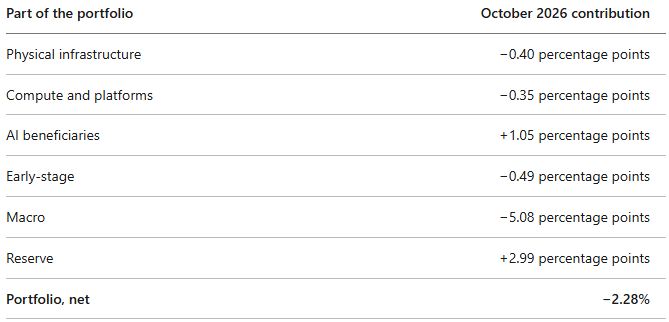
Official month ended 31 October 2026; USD; unaudited. Contributions are rounded independently.
The largest loss had nothing to do with AI demand. It came from Macro, chiefly Strategy Inc., the bitcoin-holding company, and silver, and it cost 5.08 points in a month when the Fed leaned toward tighter money. Expecting financial pressure eventually to provoke a policy response does not make the positions built for that response protective while the pressure is rising. The Reserve, which holds cash, short-term bonds and put options for protection, paid off as chip stocks fell and contributed 2.99 points, with AI beneficiaries adding 1.05. Physical infrastructure, which holds businesses on both sides of the line described above, cost only 0.40 points in a month when chips fell 14%.
At 31 October 2026, Reserve was 33.86% of the portfolio, Macro 29.27% and Physical infrastructure 13.10%. Macro has come down from 36.8% at 30 September, but the mismatch remains visible: more of the portfolio sits in monetary bets than in the physical bottlenecks central to the research, and one favourable month does not resolve that. The reserve preserves room to act if financing pressure forces good assets to change hands at better prices. It also has a cost if the boom continues and those prices never arrive. That is the choice the portfolio should be judged on, alongside the assets it owns.
Who gets paid for the wait
The next reports need to answer more than whether demand grew again. Nvidia reports in late November, and its filing will show how much more it is lending to customers, or investing in them, to keep orders flowing. Anthropic’s listing, expected during the month, will show what public investors will pay for a model company’s growth. Meta’s new share class becomes effective on 19 January, opening the door to its larger programme of share sales. And the fourth-quarter results in late January and February will show whether the builders’ cash after investment improves, on what terms they raise more, and whether suppliers’ contracts can survive a slower pace of new construction.
Go back to 29 October. Selling the fastest-growing cloud business in the world looks irrational if the question is whether AI pays. It looks rational once the question becomes who gets paid. The richest builders can still raise all the money they want, but every dollar they raise gives someone new a claim on the outcome. The most useful opportunity may be a business whose customers keep paying even when they stop expanding. To find it, follow the payment: who owes it, what earns it, and does another financing round have to close first?
When Intelligence Is Free is independent research on where economic value moves as intelligence becomes abundant. Explore the framework or see how the thesis is expressed in the live portfolio.
Concentrated, high-volatility strategy; capital may be lost. Past performance does not guarantee future results. Nothing here is investment advice or an offer.