

The railway mania of the 1840s was one of the worst investments in British history and one of the best things that ever happened to Britain. Both halves are true. Investors poured extraordinary amounts of money into railway lines based on traffic forecasts that assumed freight and passengers would eventually appear. Shares collapsed, fortunes disappeared and plenty of authorised track was never built. But the track that did get built carried the British economy for the next century. Economic historian Andrew Odlyzko calls the 1840s boom an investment disaster that nevertheless left Britain with a nationwide communication network of enormous utility. His work on the British railway manias makes the contradiction hard to miss: investors were disastrously wrong about the economics of a technology they were spectacularly right about.
A century and a half later, telecom repeated the trick with glass. The internet was obviously growing, carriers borrowed heavily to lay fibre ahead of traffic, and when some customers ran out of their own financing capacity, equipment makers helped finance the customers buying their equipment. A Canadian telecom operator, for example, disclosed a $315 million Lucent vendor-financing facility. Nortel described providing not only equipment finance but money for installation, working capital and even equity, and disclosed more than $5 billion of customer-financing exposure at the end of 2000. Its subsequent SEC filing shows what happened when capital markets closed: third-party placement became difficult, customers failed financing conditions, purchase commitments fell and provisions against the loans rose sharply.
The revenues were real while the financing lasted. Then refinancing stopped, telecom equity was destroyed, carriers went through bankruptcy and huge amounts of fibre changed hands for a fraction of what they had cost to lay. The internet did not fail. The capital structure did. And the wreckage became an input into everything that followed: broadband, cloud computing, streaming and eventually today’s AI industry inherited communications capacity that somebody else had financed at the wrong price.
That is the distinction this essay is about. The founding essay asked where value goes when intelligence gets cheap. There is a second question underneath it: when does that value move? The answer runs through the capital cycle.
1. Every revolution has a time path
Infrastructure-heavy technologies have an awkward property: they have to be built before anybody can know exactly what they will earn. You cannot wait for railway traffic before building the railway, for internet traffic before laying fibre, or for an AI-native economy before building the power plants, substations, fibre, cooling systems, data centres and compute required to run it.
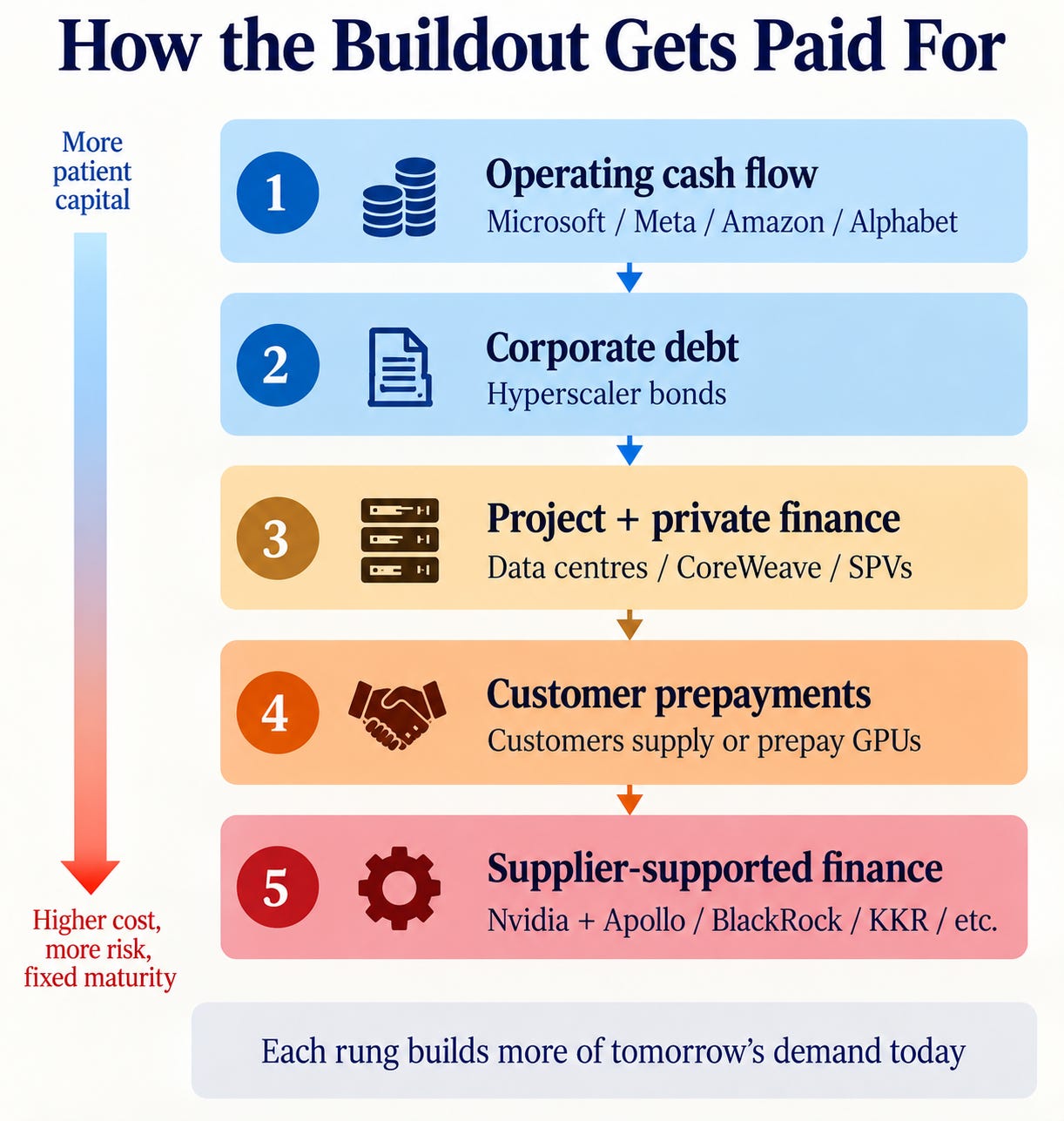
So capital finances the future backwards. An expectation supports a valuation; the valuation makes equity available; equity builds the first assets. Debt follows because it is cheaper and allows the buildout to move faster. When corporate balance sheets become constrained, project finance and private credit take more of the load. Customers prepay. Suppliers extend terms or help assemble pools of capital around their buyers. This is not a defect in technological capitalism. It is one of the reasons a new infrastructure system can be built in years rather than decades.
But it creates a predictable sequence. Buildout is when the scarce thing is infrastructure and capital earns by supplying what everybody suddenly needs. Digestion starts when the market stops asking how fast capacity can be built and starts asking what the capacity already built actually earns. Projects are cancelled, refinanced or transferred; assets once valued on scarcity get valued on cash flow. Diffusion is what the whole exercise was for: capacity exists, the cost of using it has fallen and ordinary companies can finally redesign themselves around the technology. The gain moves from building abundance to using abundance.
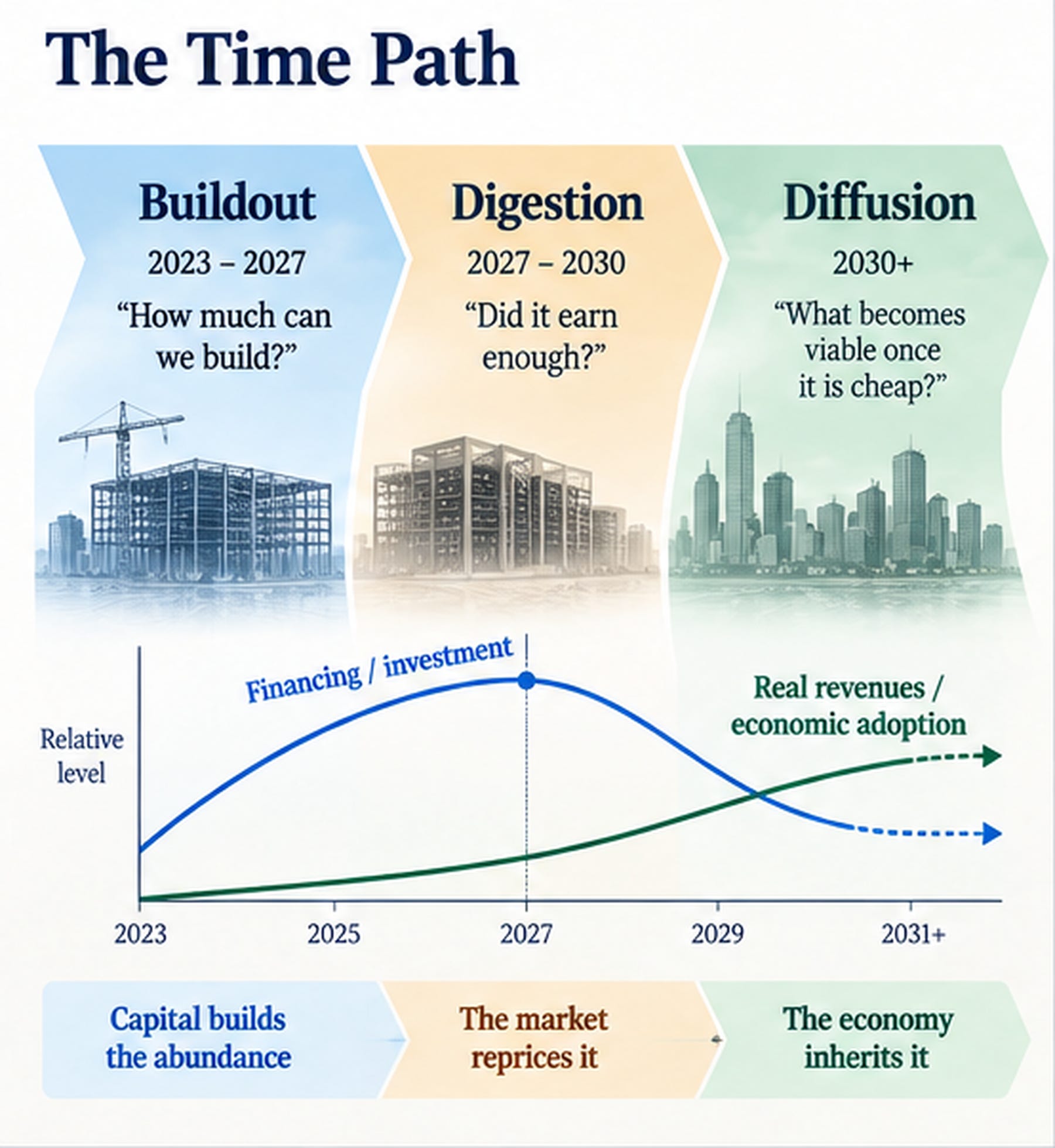
The most expensive mistake in a transition like this is therefore not being wrong about the technology. It is being completely right about the destination and standing in the wrong phase.
AI is still in Buildout. Hyperscaler spending has not rolled over, physical bottlenecks remain binding and financing markets remain open. But the thing that should weaken before spending itself does is already moving: the funding channel is becoming more expensive and more complicated. That does not mean Digestion has begun. It means the bridge toward it is becoming visible.
2. Follow the marginal dollar
Two years ago, the answer to “who pays for AI?” was almost boring. Microsoft, Amazon, Alphabet and Meta had enormous cash flows from existing businesses and strategic reasons to spend them. Internal cash is unusually patient money. Nobody calls it back because an enterprise AI programme took two years longer than expected.
That answer stopped being sufficient. By early September, hyperscalers had issued more than $200 billion of debt in 2026, already more than twice their 2025 issuance. Amazon’s latest bond sale is one visible piece of that migration. Investor appetite remains substantial, but it has become less automatic: Apollo found hyperscaler bond cover ratios falling from almost five times in February to below two by July. Its data show investors demanding more compensation as supply grows.
Oracle shows what comes next. In fiscal 2026 it generated a record $32 billion of operating cash flow and spent enough on infrastructure to leave free cash flow negative $23.7 billion. It raised $43 billion of debt and $5 billion of equity. At the same time, its backlog reached $638 billion, with $75 billion of large AI contracts already structured around customers either prepaying Oracle for GPUs or supplying the hardware themselves. Oracle’s own year-end release lays out all three sides of that equation: extraordinary demand, extraordinary capital intensity and customers increasingly helping finance the assets required to serve them.
And then Oracle supplied some useful counterevidence. On September 10, its next quarter showed backlog rising again to $664 billion, while $11.36 billion of $28.5 billion of quarterly capex was offset by customer prepayments. Management also said much of its newest contracted demand would not require proportionate new Oracle capital. The September quarter therefore cuts both ways. It shows that the financing problem is real enough for contract structure to change, but also that strong customers can move part of the burden away from Oracle’s own balance sheet. A capital cycle is not a one-way ratchet.
Then the supplier entered the financing story. On August 10, Nvidia announced partnerships with Apollo, BlackRock, Blackstone, Brookfield, Goldman Sachs and KKR intended to mobilise more than $500 billion of third-party capital for AI infrastructure. Nvidia’s announcement explicitly describes the goal as expanding the pool of capital available for compute infrastructure. Nvidia is not lending half a trillion dollars itself, which matters. But another fact matters too: the company selling the scarce equipment now considers the financing capacity of its buyers important enough to organise some of the world’s largest pools of capital around it.
Its own balance sheet points in the same direction. Nvidia ended the July quarter with $63.1 billion of receivables and 60 days of sales outstanding, up from 45 days, as it extended longer payment terms on large multi-quarter purchases by investment-grade customers. Its SEC filing says those terms can range from 90 days to one year and explicitly notes that financing arrangements and credit support will continue to affect operating cash flow. The disclosure is unusually direct.
Put the pieces together and the marginal dollar has been moving outward:
Operating cash flow from highly profitable technology companies.
Equity and corporate bonds issued against their future earnings.
Project and private finance issued against individual infrastructure assets and contracted cash flows.
Customer prepayments that fund the hardware required to fulfil the contract.
Supplier-supported finance, credit support and longer payment terms that make it easier for customers to keep buying.
These are not five mandatory stages that every company passes through in order. The important observation is simpler: more of the buildout now depends on capital with a price, a maturity date or both.
CoreWeave makes the issue unusually easy to see. Its August facility runs roughly five years while the customer contracts supporting it average about three. CoreWeave presents that, reasonably, as evidence that lenders are willing to underwrite renewal risk. The company’s own announcement says exactly that. It is also exactly what it sounds like: the currently contracted revenue expires before the loan does.
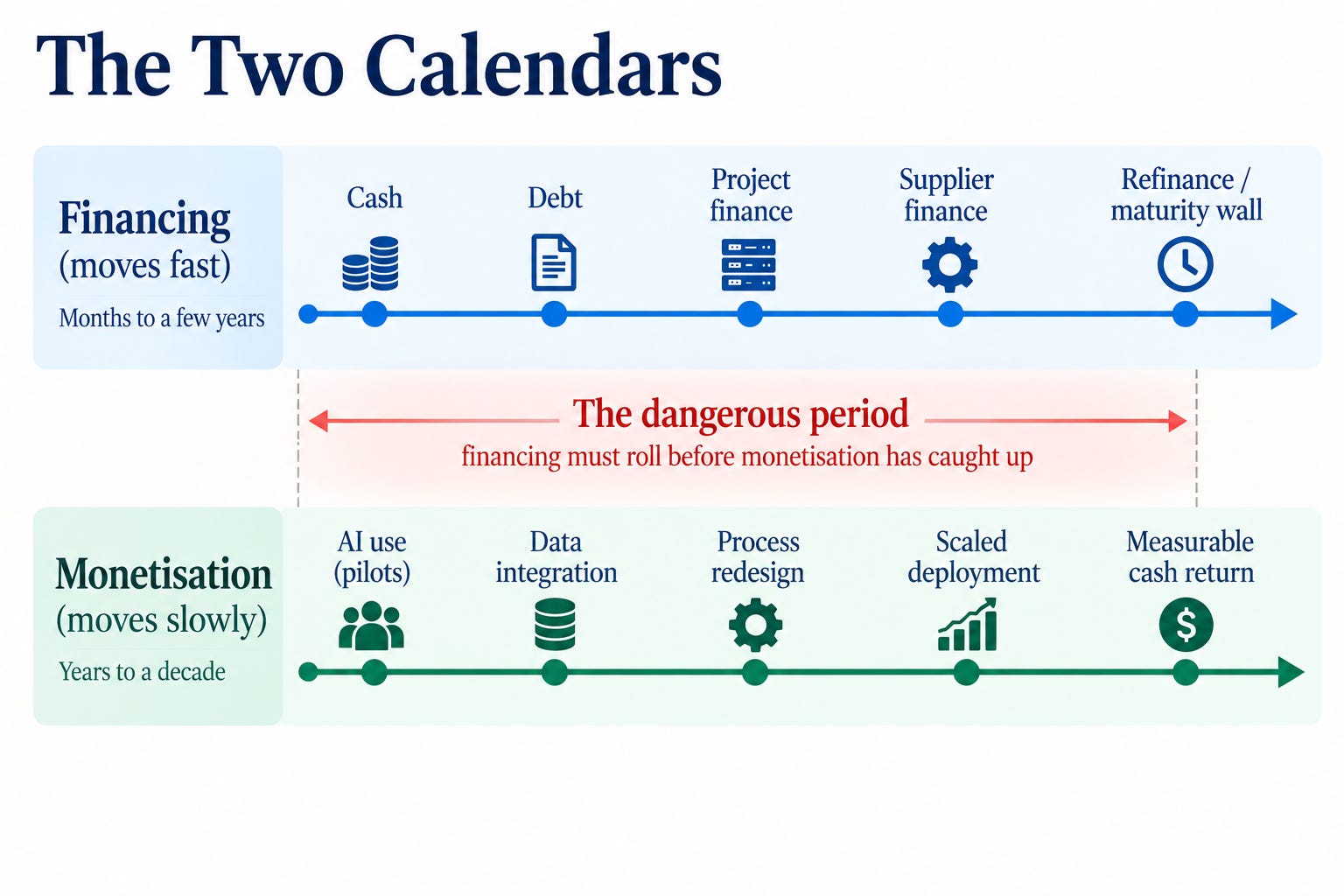
At June 30, CoreWeave’s quarterly revenue had more than doubled to $2.575 billion, while net interest expense reached $640 million. The Q2 filing shows the scale of both the growth and the financing burden. The growth is real. The financing is real. They run on different calendars.
That mismatch is completely ordinary for a toll road. A road can support thirty-year debt because the useful life of the road is the least controversial assumption in the model. A rack of accelerators is not a road. The machine may still switch on perfectly in 2031; what nobody can tell you today is what an hour of its output will be worth.
3. Revenue is real. That is not the same as saying the economic loop has closed.
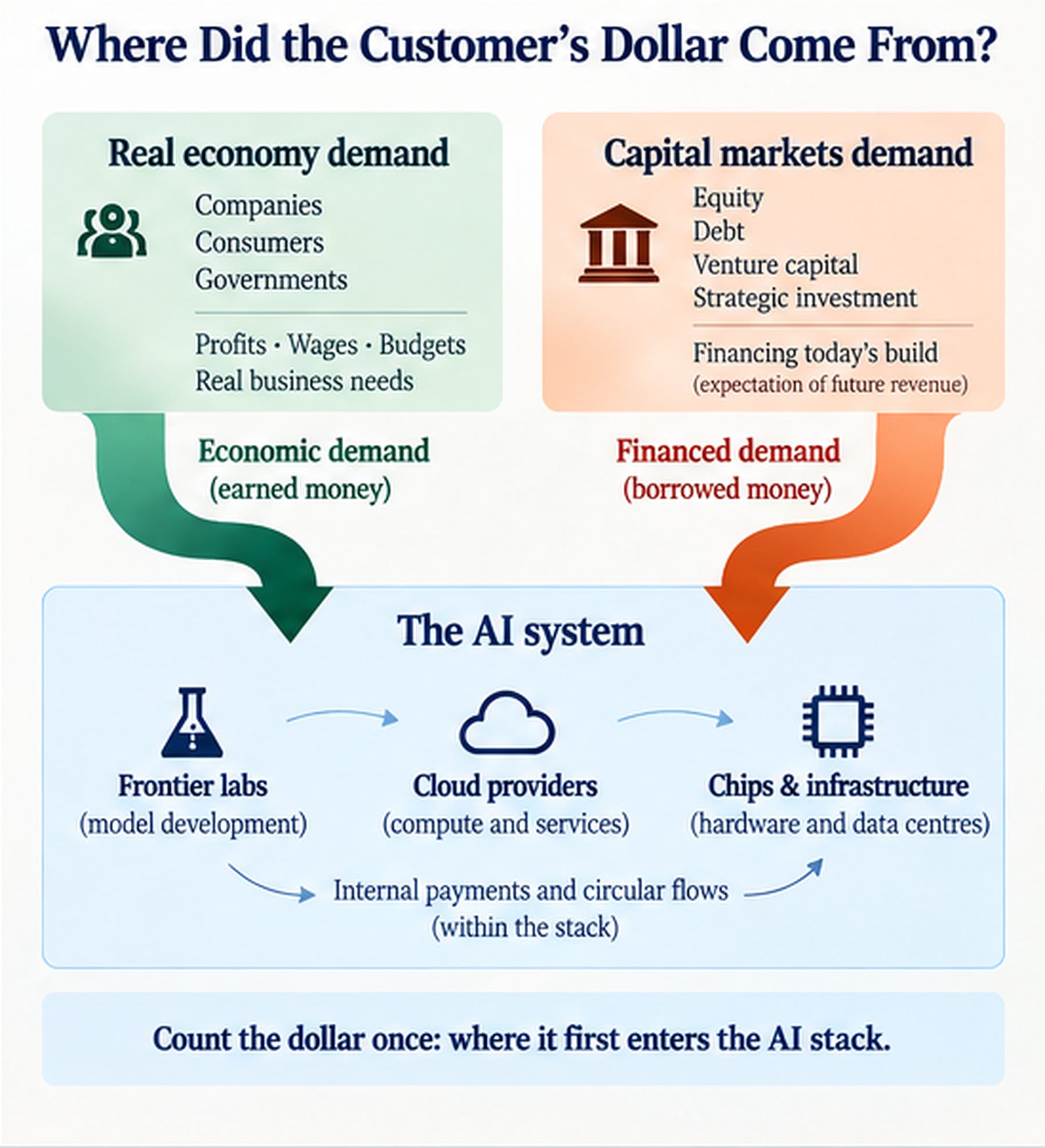
This is where the AI debate becomes unnecessarily binary. One side sees huge AI revenues and concludes that monetisation is proven. The other notices capital circulating among the same companies and calls the revenue fake. Both shortcuts miss the interesting question: where did the customer’s dollar come from?
Suppose a manufacturer earns $100 selling machines and spends $5 of the resulting cash on AI because AI reduced its costs. That dollar entered the AI economy from outside. It is external economic demand. Now suppose an AI company raises $10 billion and spends several billion of it on cloud compute. The cloud provider has earned perfectly real revenue, but the payer is funding the purchase with new capital rather than cash generated by its own customers. That is financed demand. The AI company pays the cloud, the cloud buys accelerators, and the accelerator supplier may invest back into the lab or infrastructure provider. Those are internal stack payments. Sometimes disclosure simply does not tell us where the payer’s money ultimately came from, leaving the provenance unresolved.
All reported revenue remains revenue. But aggregate economic demand should be counted only once, where money enters the AI stack from outside it. Otherwise the same dollar can appear economically larger every time it moves between a lab, cloud provider and supplier.
Microsoft gives us an unusually useful glimpse. Its 2026 annual report says Microsoft owns roughly 25% of OpenAI on an as-converted basis, had funded $11.9 billion of a $13 billion investment commitment, and simultaneously recorded $24.1 billion of revenue from commercial arrangements with OpenAI, with $6 billion still receivable at year-end. Microsoft discloses the related-party economics directly in its 10-K. Azure delivered real services and Microsoft earned real revenue. But the payer is also a company partly financed by Microsoft and other participants in the same capital cycle.
Amazon produces an even larger version of the same pattern. By June it carried $28.7 billion of OpenAI preferred stock; AWS had expanded OpenAI’s cloud commitment from $38 billion by another $100 billion over eight years. Amazon had also invested another $10 billion in Anthropic during the quarter while Anthropic expanded its AWS commitment to more than $100 billion over ten years. Those figures come from Amazon’s own filing. Alphabet has its own version: Anthropic reportedly committed about $200 billion to Google Cloud and related chips while Alphabet was simultaneously investing up to $40 billion in Anthropic. Reuters reported the relationship in May.
None of this is evidence of accounting fraud. Strategic investment, customer finance and supplier finance have existed for centuries. The telecom analogy matters for a much more mundane reason: revenue funded by a customer’s operating profits and revenue funded by a customer’s latest capital raise look much more similar on the supplier’s income statement than they do when the financing window closes.
The balancing evidence is equally important. OpenAI’s annualised revenue run rate reportedly passed $40 billion in August, driven by paying consumers, enterprises and coding products. Bloomberg’s reporting shows how quickly genuine outside demand is scaling. Microsoft says its cloud business exceeded $214 billion of annual revenue and nearly 90% came from customers outside frontier-model companies; all sequential RPO growth in its latest quarter came from customers outside the frontier labs. Microsoft’s earnings call is unusually helpful on this point.
So AI has real end demand. The unresolved question is whether outermost economic demand is growing as fast as the infrastructure obligations being accumulated upstream. The industry publishes exquisite statistics on tokens, model scores, GPU shipments and contracted backlog. The number I most want barely exists: what percentage of the marginal AI infrastructure dollar is ultimately being paid from cash generated outside the AI capital cycle?
That is the number Digestion will force the market to find.
4. The technology can move too fast while the customer moves too slowly
The monetisation problem is not one problem. Three mechanisms push on the same future cash flow from different directions.
Enterprises move slowly
Enterprise adoption is real and already broad. Stanford’s 2026 AI Index found 88% of surveyed organisations using AI in at least one function, while agent deployment remained in the single digits across almost every business function. The distance between those numbers is more important than either number alone.
An employee asking a model to draft a presentation is adoption. A bank rebuilding credit underwriting around agents is diffusion. The first takes an afternoon; the second runs into old databases, fragmented permissions, security controls, regulatory rules, procurement, works councils, budget cycles and managers with perfectly rational reasons not to redesign a process that currently works. This is the electrification problem all over again: the large productivity gains did not arrive when factories merely swapped steam for an electric motor, but when the factories themselves were redesigned around what electricity made possible.
AI distributes much faster than electricity ever could, so the analogy has limits. Organisations are still organisations. One calendar is measured in model releases, another in transformation programmes, and infrastructure debt sits between them with its own maturity date.
The product improves too quickly
Waiting for enterprise diffusion would be easier if intelligence itself were economically stable. It is not. Stanford’s technical-performance data show frontier systems gaining around 30 percentage points in a year on Humanity’s Last Exam, while OSWorld accuracy rose from roughly 12% to 66.3%. Benchmarks expected to remain difficult for years are being consumed in months.
For society, this is excellent news. For infrastructure underwriting, it creates a nasty question: how much compute will the economy need in 2029 to produce one unit of useful intelligence? One possibility is Jevons: intelligence gets dramatically cheaper, workloads multiply even faster and total compute demand explodes. The opposite is that efficiency outruns new workload creation and a business process requiring 100 units of compute today needs ten by the time an enterprise finally puts it into production.
Both can be true across different workloads. Today’s infrastructure is therefore financed against the intersection of two curves that are moving violently: how much intelligence the economy wants and how much compute is required to produce it. A 2026 accelerator does not compete only with other 2026 accelerators. It competes with 2029.
China is attacking the clearing price
Then there is China. The American strategy has effectively been to spend vastly more money, build the best models on the best hardware, and recover the investment because superior intelligence commands a premium. That works exactly as long as the premium survives.
The numbers are getting uncomfortable. Stanford says the U.S.–China performance gap between leading models had fallen to just 2.7% by March 2026, while its economic data say U.S. private AI investment was about 23 times China’s. The technical comparison is here; the investment comparison is here. Those are different measures, not a return-on-capital calculation. The juxtaposition is still hard to ignore: twenty-three times the private investment for a frontier whose measured performance lead is now in the low single digits.
Price differences are much larger than capability differences. DeepSeek currently lists V4 Pro at $0.435 per million uncached input tokens and $0.87 per million output tokens. Its current API price sheet is public. OpenAI’s GPT-5.5 is $5 per million input and $30 per million output tokens. OpenAI publishes those prices here. They are not identical products and raw token pricing is not a quality-adjusted benchmark. But on output price alone the gap is more than thirtyfold, and most corporate workloads do not need the world’s best model at any price.
A German manufacturer, Brazilian bank or Indian retailer does not get paid for winning an AI benchmark. It gets paid for producing an economic result. If almost all the useful capability for a task can be purchased at a small fraction of the price, frontier intelligence stops being a strategic necessity for that task and becomes a procurement choice.
China also sits on a very different physical base. It generated about 10,578 TWh of electricity in 2025 against 4,520 TWh in the United States. Pew’s compilation of Ember data shows the comparison directly. China remains constrained by advanced chips and high-bandwidth memory, but those constraints have also given its labs unusually strong incentives to squeeze more intelligence from the compute they can access.
Elon Musk made the geopolitical consequence unusually blunt in his July interview with The Economist: the two hard constraints are chips and electricity; China has a credible path to leadership; and Washington can stop American companies using Chinese models but cannot stop the rest of the world using them. The relevant part of the interview is transcribed here.
The strong conclusion is not “China wins AI.” Chinese open weights can run in an American data centre, which could damage the U.S. model provider while leaving the American power connection, fibre and building economically valuable. Model weights can cross an ocean in an afternoon. A substation cannot. The narrower and harder claim is that China can help set the global clearing price of intelligence without owning the whole stack.
That clearing price is what today’s buildout eventually has to earn against.
5. Put the two sides together
The financing side is pulling more future cash flow into the present while the monetisation side is being pushed the other way. Enterprises may take years to reorganise enough of their businesses to produce the full economic return. When they finally do, better models may require less compute for the same task. When they buy that intelligence, Chinese and open competitors may have pushed its market price far below the assumptions embedded in today’s investments. And during the waiting period, some of the largest buyers of infrastructure are still financing their spending with capital raised from the same ecosystem.
None of this requires AI demand to collapse. That is the point. The dangerous outcome for a leveraged buildout is strong adoption that arrives late, uses less expensive compute and pays lower unit prices than the capital structure assumed. Users can win, AI usage can explode and capability can keep improving while the infrastructure’s first owners earn terrible returns.
In fact, AI may create its own financing problem precisely by succeeding at its core economic mission: making intelligence abundant.
That is how Buildout eventually turns into Digestion. It rarely happens because everyone simultaneously decides a technology was useless; it happens because the next investor refuses to finance yesterday’s assumptions at yesterday’s price. A refinancing comes back wider, a customer signs three years instead of ten, a lender reduces the collateral value of used accelerators, a project requires more equity and gets postponed. Higher financing costs then reduce project values, weaker collateral reduces borrowing capacity, fewer projects reduce marginal equipment demand, and falling equipment values make lenders more conservative again.
Nothing in that sequence requires the models to get worse. This is why “AI bubble” is too crude a description. A bubble says the thing was mostly an illusion. A capital cycle says the thing was extremely valuable and financed at the wrong price.
Those stories have very different endings.
And importantly, we are not at that ending yet. Capital remains available, hyperscaler capex has not rolled over and physical bottlenecks still bind. CoreWeave closed its financing; Nvidia assembled new pools of capital; Oracle just demonstrated that customer prepayments can materially reduce its own financing requirement. The window is getting more expensive and more inventive, but it is still open.
That makes the funding migration useful as a clock, not as a crash call.
6. A reset would not hit “AI infrastructure” equally
Calling the whole buildout “AI infrastructure” hides a crucial difference. A data centre is not one economic asset. Part of it can last decades: land with the right permissions, transmission access, grid connections, substations, fibre routes, cooling systems and sometimes generation. Another part lives on a technology treadmill: accelerators, servers, networking generations and software layers whose advantage can disappear in a few hardware or model cycles.
A reset separates those layers brutally. A 2026 GPU whose economic life turns out to be three years instead of six can lose most of its value while the site housing it becomes more valuable because getting another powered site takes five years. A lab can lose its model premium while the electricity supplier keeps collecting rent. Chinese weights can run on American compute. The software becomes abundant; the physical permission to run it does not.
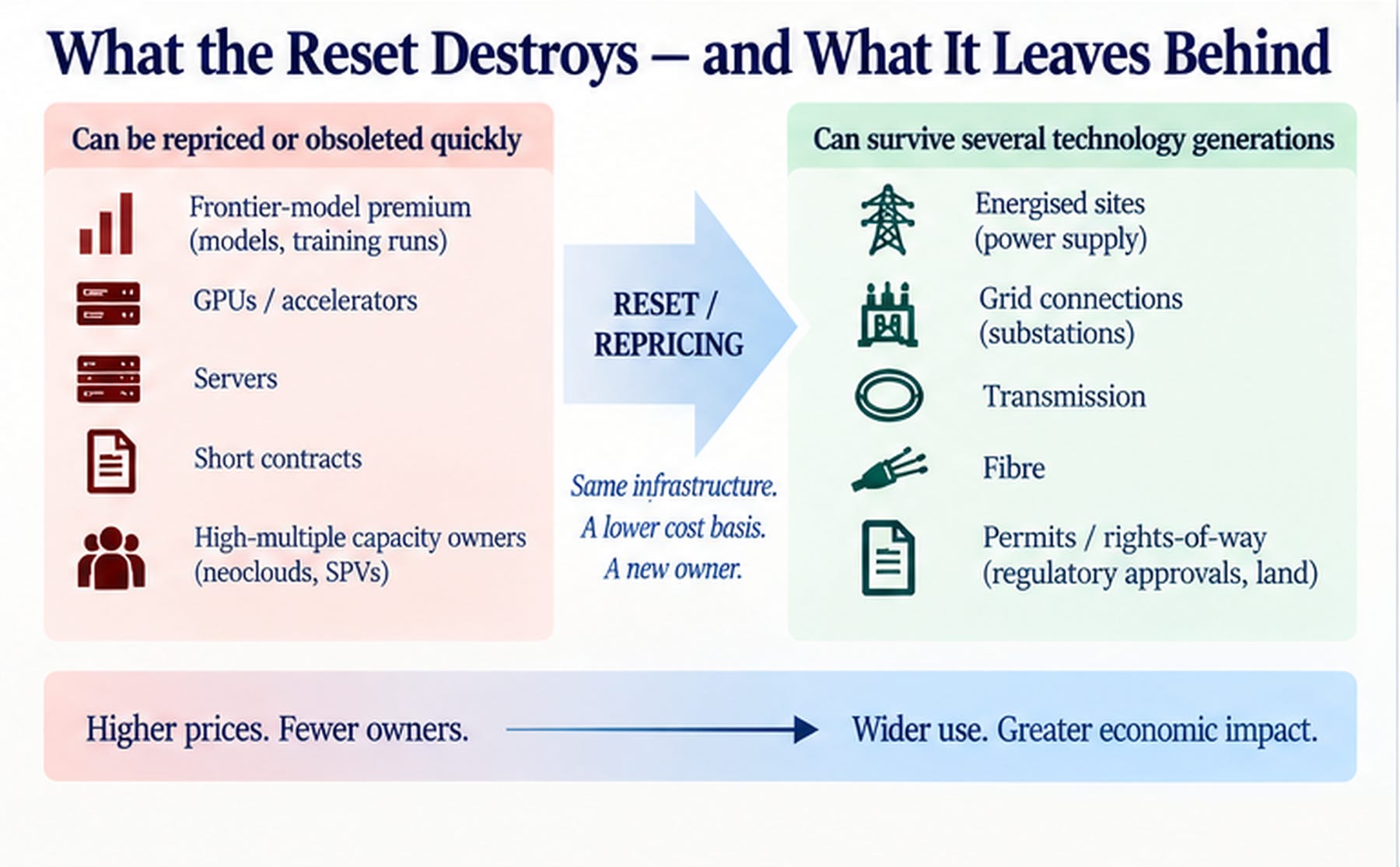
That is why the handoff from Digestion to Diffusion matters more than the crash itself. When railway equity collapsed, the track stayed. When telecom companies failed, the fibre stayed. If the first AI capital cycle breaks, the useful physical layer does not disappear either. Some unfinished projects will die, but enormous quantities of functioning infrastructure will simply acquire new owners and new prices.
A data centre that was mediocre at a $20 billion valuation can be excellent at $8 billion. Compute that cannot support the first owner’s financing cost can become an extraordinary input for the second owner. An application that makes no economic sense when inference costs $30 can become obvious at $1.
The first wave pays to manufacture abundance. Digestion removes the return assumptions attached to manufacturing it. Diffusion inherits what survives at a lower cost basis.
That is not a side effect of the capital cycle. It may be the mechanism by which the technology becomes cheap enough to transform everything else.
7. There is one more balance sheet underneath all of this
Normally a private credit cycle has one final source of optionality: the state. The United States is entering this one with less room than usual. Federal debt crossed $40 trillion in August, including roughly $32.3 trillion held by the public. Treasury figures reported by Reuters show the milestone and the composition. The Congressional Budget Office projects a $1.9 trillion deficit for fiscal 2026, equal to 5.8% of GDP, with debt held by the public rising from about 101% of GDP this year to 120% by 2036 under current law. The CBO baseline is here.
The same capital market is therefore being asked to finance two extraordinary things at once: the accumulated promises of the American state and the largest private infrastructure programme of the AI era. The government has options, but none make the underlying arithmetic disappear.
Treasury has already increased its liquidity-support buybacks in longer-dated securities. Its August announcement raised the planned long-end operations from $2 billion to at least $4 billion each; in September it increased the first 10-to-20-year operation to as much as $6 billion. Reuters reported the expansion here. These are debt-management operations intended to improve market liquidity, not quantitative easing. That distinction matters. What also matters is that the functioning of the long end has become something Treasury is actively spending balance-sheet capacity to improve.
If a private AI financing problem eventually becomes large enough to demand intervention while inflation remains elevated, the policy menu becomes uncomfortable. The state can guarantee infrastructure, become a customer or alter regulation so balance sheets can carry more of it. Fiscal policy can cut spending or raise taxes. The central bank can eventually ease if inflation permits. And if market-clearing rates become politically or fiscally unbearable, some combination of monetary accommodation and financial repression can move the adjustment away from defaults and toward purchasing power.
None of these choices makes an economically bad asset produce an economically good return. They change who absorbs the loss.
Ray Dalio’s debt-cycle framework is useful here in this narrow mechanical sense. When debt service consumes more income and the supply of claims outruns buyers willing to absorb them at prevailing rates, either rates rise enough to choke activity or money is created to prevent the adjustment. His 2026 HBR discussion lays out the mechanism directly. His broader argument about changing powers should be treated more cautiously, because China has severe debt, demographic, property and capital-market problems of its own and the dollar has no obvious reserve-scale replacement.
But there is one uncomfortable intersection between the two stories. America could finance the world’s most expensive first generation of intelligence abundance while Chinese competition helps determine how little the final product sells for. The United States can still benefit enormously from that outcome: its enterprises get cheaper intelligence, consumers get better products, and scarce American power and infrastructure may remain valuable. What can disappear is the premium expected by some of the capital that financed the frontier.
The country can win. The technology can win. The customers can win enormously. The original investors can still lose.
That is not an exotic outcome. It is what happened before.
8. The clean escape route is also the hardest one
There is an elegant way for the system to work without a serious reset: AI simply works fast enough. Enterprise productivity accelerates, falling intelligence prices unlock so many workloads that total compute demand outruns every efficiency gain, and normal businesses start sending operating cash into the AI stack faster than the stack needs fresh financing. Hyperscaler cash generation catches up with capex, frontier labs become increasingly self-funding, refinancing spreads stabilise and infrastructure earns its cost of capital even as intelligence gets cheaper.
That outcome could also help the sovereign side. A sufficiently large productivity shock raises real output, lowers production costs, expands the tax base and creates the technological deflation needed to offset some of the inflationary pressure from public borrowing. Today’s extraordinary infrastructure spending would then look less like an excess and more like the bridge that arrived just in time.
It is possible. It also requires several clocks to line up unusually well: capital markets move quarterly, hardware depreciates over years, models improve every few months, large enterprises reorganise over several years and transmission infrastructure can take close to a decade. The system does not need perfect synchronisation. It does need the cash to arrive before enough providers of capital decide they have waited long enough.
The strongest ways this essay could be wrong are therefore straightforward:
Cash flow reclaims the buildout. If operating cash flow begins covering more of capex and reliance on debt, project structures and supplier-supported capital falls, the financing clock gains years.
Outermost economic demand accelerates. If enterprises and consumers increasingly fund AI from their own operating cash rather than frontier companies continuing to depend on fresh capital, the payer-provenance problem resolves in the bullish direction.
Jevons wins decisively. If intelligence becomes ten times cheaper and that creates one hundred times more compute demand, efficiency strengthens the infrastructure thesis rather than weakening it.
Enterprise restructuring happens unusually fast. AI distributes through software and cloud infrastructure that already exist, giving it an enormous advantage over railway construction or factory electrification.
The cycle grinds rather than breaks. Private credit can amend and extend, hyperscalers can cancel marginal projects before credit deteriorates, strong balance sheets can absorb weak ones and governments can move private risk onto public balance sheets.
China fails to turn low prices into global economics. Chip controls, memory constraints, regulation, security concerns and geopolitics could preserve a much larger premium for the Western stack than current model prices suggest.
The most likely way to be wrong, however, is the boring one: the mechanism is right and the calendar is early. Telecom vendor finance did not collapse the moment it appeared. It extended the cycle. Being right about a capital cycle and wrong about when it turns is still being wrong.
9. Five numbers matter more than another benchmark
The first number is who funds the marginal dollar of capex. If infrastructure spending moves back toward operating cash flow, the system is becoming healthier; if it continues migrating toward credit, project structures, prepayments and supplier-supported finance, the first clock is running further.
The second is where the customer’s dollar originated. How much incremental AI demand is funded by external enterprise and consumer cash, how much by customers themselves consuming fresh capital, how much is internal circulation through the stack, and how much remains impossible to classify from public disclosure?
The third is actual enterprise cash return. Counts of people using copilots are becoming almost useless. Margin improvement, revenue per employee, operating savings, throughput and cycle-time reductions matter much more.
The fourth is the race between efficiency and consumption. If useful intelligence becomes ten times cheaper while compute consumption rises one hundred times, today’s infrastructure bulls win. If consumption rises three times, a lot of underwriting has to be revisited.
The fifth is the global clearing price of intelligence. Chinese model quality, open weights, inference pricing, accelerator efficiency and electricity availability matter because American AI does not ultimately compete only against another American model. It competes against the cheapest acceptable way to produce intelligence anywhere a customer can legally and practically buy it.
And underneath all five sits the cost of long-duration capital.
Those measures will tell us more about the time path than another argument over whether AGI arrives in 2028 or 2032.
The strange way technology becomes cheap
We like technological history to have a clean sequence: someone invents something useful, companies adopt it, productivity rises and everyone becomes richer. The real sequence is much less polite. Capital sees a future before the future exists and races ahead of it. Equity turns the story into companies; credit turns the companies into physical infrastructure; competition keeps building after the obvious opportunities have already been funded. Expectations that existed only in spreadsheets eventually become steel, copper, silicon and debt.
Then the future actually arrives. It arrives later than somebody promised, with better technology than somebody modelled, using less of some inputs and more of others, and at prices that were not in the financing documents when the debt was issued. That is when the capital structure finds out whether being right about the future was enough. Usually it wasn’t. Assets get repriced, owners change and the useful infrastructure remains, leaving the second generation with something the first generation never had: abundance without having to pay the original cost of creating it.
That is why this story is more interesting than “AI bubble” versus “AI boom.” AI can work. Enterprise demand can become enormous. Models can continue improving. Intelligence can become one of the most important factors of production in the economy. And the people who financed its first version can still lose money.
Railway investors financed transportation abundance and failed to capture much of it. Telecom investors financed bandwidth abundance and failed to capture much of it. Their losses were real, and so was everything that became possible because they had overbuilt. AI may repeat the pattern: the people financing intelligence abundance today may discover that abundance is precisely what destroys some of the economics they financed.
If that happens, the reset will not mean the AI buildout failed. It will mean it worked well enough to move into the next phase. The first owners finance scarcity; Digestion discovers what their assets are actually worth; Diffusion gets what survives.
Which leaves the same contradiction we started with, and perhaps the one worth remembering:
AI can become one of the best things that ever happened to the economy and one of the worst investments made by some of the people who paid to build it.
Those statements can both be true.
They have been before.
When Intelligence Is Free is independent research on where economic value moves as intelligence becomes abundant. Explore the framework, see how the thesis is expressed in the public investment book, or apply the same reasoning to a company or market decision through advisory.